寫於 2014.4.14
按:高槓桿操作,猶如駕駛一級方程式賽車,大錯代價嚴重。
Def: 良好的交易狀態必須同時符合以下特點,缺一不可。
1. 著緊
2. 負責
3. 信念
4. 目標清晣
5. 感動
6. 注意力集中
7. 靈活
8. 對危險異常敏銳
9. 心無雜念,不存無謂的希望
10. 止蝕乾脆
The Fundamental Rule of Trading: Equity Curve 如實反映交易狀態。
生存之道:倉位與交易狀態成正比。
Corollary 1: 倉位大而交易狀態差,滅亡之道。
Corollary 2: When in doubt, get out of the position.
狀態差眾多表徵:
1. 倉位虧蝕太快,不捨得止蝕,動作停滯。違反「止蝕乾脆」。
2. 希望市場向利好倉位一方走。違反「心無雜念」及「注意力集中」。
3. 損失不菲,卻不覺危險,感覺輕鬆。違反「著緊」。
4. 唔識轉身。違反「靈活」。
5. 長勝之後,渾忘危險。 違反「對危險異常敏銳」。
6. 渾渾噩噩。違反「負責」。
7. 理性,忽略情感。違反「感動」。
8. 無目標。違反「信念」及「目標清晣」。
9. 雜務纏身。違反「注意力集中」。
2014年8月14日 星期四

2014年7月13日 星期日
市場動態分析的思考過程
寫於 2013-9-26
跟下象棋相似。
下棋時的思考過程:
1. 對手剛才的一手棋有甚麼目的?
2. 就對方的意圖,有甚麼針對性應着?
3. 推算和評估每步應着是否可行,選出最佳着手。
市場動態分析的思考過程:
1. 解釋當前局面。
重要新聞的含意,市價的解讀。市場上升/下跌的主要原因。
市場參與者的取態:謹慎或者進取?
貨幣面的觀察:放鬆或是收緊?
「圓」的應用 -- 概覽不同行業、市值的股票股價圖,看清市場深度。
跨資產類觀察與聯想:匯、美股、歐股、中國股市、新興市場股市、樓、債、金、油、貨幣政策、經濟數據、通脹。
「異象」必須解讀!面對重要的市場現象而未能理解的「異象」,必須挖盡心思解讀。每一個疑惑,都可以導致將來覆沒。
2. 思考市場方向可能性:市,行業,個股。
日常資訊只有少於 5%是講將來的遠見,絶大部份是講現在的新聞報導。
名 人遠見:Soros, Druckenmiller, Jeremy Grantham, David Tepper, Gunlach, Ray Dalio, Kyle Bass,李嘉誠,任志剛(金管局總裁時期),曹仁超(投資者日記時期),雷賢達,陶冬,劉國傑,繆子美,張五常。
技術分析的角度。
基金經理的角度。
市場流行觀點的解讀和背後理據。
評估主要力量和次要力量的消長,政策當局的可能應變手段。
留心隱蔽的趨勢轉變:貨幣面的變化,宏觀股市盈利趨勢之變化,通脹的潛伏。解讀「異象」。
3. 預視
押注隱蔽的趨勢轉變。同時,緊記自己可能錯,甚至錯得離譜,必須逃命。
市場是遠見之爭。
"Markets are constantly in a state of uncertainty and flux and money is made by discounting the obvious and betting on the unexpected." - George Soros
跟下象棋相似。
下棋時的思考過程:
1. 對手剛才的一手棋有甚麼目的?
2. 就對方的意圖,有甚麼針對性應着?
3. 推算和評估每步應着是否可行,選出最佳着手。
市場動態分析的思考過程:
1. 解釋當前局面。
重要新聞的含意,市價的解讀。市場上升/下跌的主要原因。
市場參與者的取態:謹慎或者進取?
貨幣面的觀察:放鬆或是收緊?
「圓」的應用 -- 概覽不同行業、市值的股票股價圖,看清市場深度。
跨資產類觀察與聯想:匯、美股、歐股、中國股市、新興市場股市、樓、債、金、油、貨幣政策、經濟數據、通脹。
「異象」必須解讀!面對重要的市場現象而未能理解的「異象」,必須挖盡心思解讀。每一個疑惑,都可以導致將來覆沒。
2. 思考市場方向可能性:市,行業,個股。
日常資訊只有少於 5%是講將來的遠見,絶大部份是講現在的新聞報導。
名 人遠見:Soros, Druckenmiller, Jeremy Grantham, David Tepper, Gunlach, Ray Dalio, Kyle Bass,李嘉誠,任志剛(金管局總裁時期),曹仁超(投資者日記時期),雷賢達,陶冬,劉國傑,繆子美,張五常。
技術分析的角度。
基金經理的角度。
市場流行觀點的解讀和背後理據。
評估主要力量和次要力量的消長,政策當局的可能應變手段。
留心隱蔽的趨勢轉變:貨幣面的變化,宏觀股市盈利趨勢之變化,通脹的潛伏。解讀「異象」。
3. 預視
押注隱蔽的趨勢轉變。同時,緊記自己可能錯,甚至錯得離譜,必須逃命。
市場是遠見之爭。
"Markets are constantly in a state of uncertainty and flux and money is made by discounting the obvious and betting on the unexpected." - George Soros
2013年2月27日 星期三
有夢想的人才能舉起奧斯卡 by 李安﹝轉載﹞
按:求道真苦!
----------------------------
引用自:http://blog.voc.com.cn/blog_showone_type_blog_id_55946_p_1.html
1978年,當我準備報考美國伊利諾大學的戲劇電影系時,父親十分反感,他給我舉了一個數字:在美國百老匯,每年 只有200個角色,但卻有50000人要一起爭奪這少得可憐的角色,當時我一意孤行,決意登上了去美國的班機,父親和我間的關係從此惡化,近二十年間和我的話不超過100句!
但是,等我幾年後從電影學院畢業後,我終於明白了父親的苦心所在。在美國電影界,一個沒有任何背景的華人要想混出名堂來,談何容易!從1983年起,我經過了6年多的漫長而無望的等待,大多數時候都是幫助劇組看看器材、做點剪輯助理、劇務之類的雜事。最痛苦的經歷是,曾經拿著一個劇本,兩個星期跑了三十多家公司,一次次面對別人的白眼和拒絕。
這樣的奔波畢竟還有希望,最怕的是拿著一個劇本,別人說可以,然後這裡改、那裡改,改完了等投資人的意見,意見出來了再改,再等待,可最終還是石沉大海,沒了消息。
那時候,我已經將近30歲了。古人說:三十而立。而我連自己的生活都還沒法自立,怎麼辦?繼續等待,還是就此放棄心中的電影夢?幸好,我的妻子給了我最及時的鼓勵。
妻子是我的大學同學,但她是學生物學的,畢業後她就在當地一家小研究室做藥物研究員,薪水少得可憐。那時候我們已經有了大兒子李涵,為了緩解內心的愧疚,我每天除了在家裡讀書、看電影,寫劇本外,還包攬了所有家務,負責買菜做飯帶孩子,將家裡收拾得乾乾淨淨。還記得那時候,每天傍晚做完晚飯後,我就和兒子從在門口,一邊講故事給他聽,一邊等待「英勇的獵人媽媽帶著獵物回家。」
這樣的生活對一個男人來說,是很傷自尊心的。有段時間,岳父母讓妻子給我一筆錢,讓我拿去開個中餐館,也好養家餬口,但好強的妻子拒絕了,把錢還給了老人家。我知道了這件事後,輾轉反側想了好幾個晚上,終於下定了決心,也許這輩子電影夢都離我太遠了,還是面對現實吧!
後來,我去了社區大學,看了半天,最後心酸地報了一門電腦課。在那個生活壓倒一切的年代裡,似乎只有電腦可以在最短時間內讓我有一技之長了。那幾天我一直萎靡不振,妻子很快就發現了我的反常,細心的她發現了我包裡的課程表。那晚,她一宿沒和我說話。
第二天,去上班之前,她快上車了,突然,她站在台階下轉過身來,一字一句地告訴我:「安,要記得你心裡的夢想!」
那一刻,我心裡像突然起了一陣風,那些快要淹沒在庸碌生活裡的夢想,像那個早上的陽光,一直直射進的心底。妻子上車走了,我拿出袋裡的課程表,慢慢地撕成碎片,丟進了門口的垃圾筒。
後來,我的劇本得到基金會的贊助,開始自己拿起了攝像機,再到後來,一些電影開始在國際上獲獎。這個時候,妻子重提舊事,她才告訴我:「我一直就相信,人只要有一項長處就足夠了,你的長處就是拍電影。學電腦的人那麼多,又不差你李安一個!你要想拿到奧斯卡的小金人,就一定要保證心裡有夢想。」
不管這個曾經的夢有多遙遠,如今它畢竟部分地實現了。1991年4月,我的第一部正式電影《推手》由台灣中央電影公司投資,在紐約庫德瑪西恩公司製片開拍時,有人拿了一個木盒子給我,說:「導演,你坐這兒。」沒有人注意到,當時我快飄起來了,第一次有人正式稱我為「導演」。我覺得自己的忍耐、妻子的付出有了回報,同時也讓我更加堅定,一定要在電影這條路上一直走下去。因為,我心裡永遠有一個關於電影的夢。
----------------------------
引用自:http://blog.voc.com.cn/blog_showone_type_blog_id_55946_p_1.html
1978年,當我準備報考美國伊利諾大學的戲劇電影系時,父親十分反感,他給我舉了一個數字:在美國百老匯,每年 只有200個角色,但卻有50000人要一起爭奪這少得可憐的角色,當時我一意孤行,決意登上了去美國的班機,父親和我間的關係從此惡化,近二十年間和我的話不超過100句!
但是,等我幾年後從電影學院畢業後,我終於明白了父親的苦心所在。在美國電影界,一個沒有任何背景的華人要想混出名堂來,談何容易!從1983年起,我經過了6年多的漫長而無望的等待,大多數時候都是幫助劇組看看器材、做點剪輯助理、劇務之類的雜事。最痛苦的經歷是,曾經拿著一個劇本,兩個星期跑了三十多家公司,一次次面對別人的白眼和拒絕。
這樣的奔波畢竟還有希望,最怕的是拿著一個劇本,別人說可以,然後這裡改、那裡改,改完了等投資人的意見,意見出來了再改,再等待,可最終還是石沉大海,沒了消息。
那時候,我已經將近30歲了。古人說:三十而立。而我連自己的生活都還沒法自立,怎麼辦?繼續等待,還是就此放棄心中的電影夢?幸好,我的妻子給了我最及時的鼓勵。
妻子是我的大學同學,但她是學生物學的,畢業後她就在當地一家小研究室做藥物研究員,薪水少得可憐。那時候我們已經有了大兒子李涵,為了緩解內心的愧疚,我每天除了在家裡讀書、看電影,寫劇本外,還包攬了所有家務,負責買菜做飯帶孩子,將家裡收拾得乾乾淨淨。還記得那時候,每天傍晚做完晚飯後,我就和兒子從在門口,一邊講故事給他聽,一邊等待「英勇的獵人媽媽帶著獵物回家。」
這樣的生活對一個男人來說,是很傷自尊心的。有段時間,岳父母讓妻子給我一筆錢,讓我拿去開個中餐館,也好養家餬口,但好強的妻子拒絕了,把錢還給了老人家。我知道了這件事後,輾轉反側想了好幾個晚上,終於下定了決心,也許這輩子電影夢都離我太遠了,還是面對現實吧!
後來,我去了社區大學,看了半天,最後心酸地報了一門電腦課。在那個生活壓倒一切的年代裡,似乎只有電腦可以在最短時間內讓我有一技之長了。那幾天我一直萎靡不振,妻子很快就發現了我的反常,細心的她發現了我包裡的課程表。那晚,她一宿沒和我說話。
第二天,去上班之前,她快上車了,突然,她站在台階下轉過身來,一字一句地告訴我:「安,要記得你心裡的夢想!」
那一刻,我心裡像突然起了一陣風,那些快要淹沒在庸碌生活裡的夢想,像那個早上的陽光,一直直射進的心底。妻子上車走了,我拿出袋裡的課程表,慢慢地撕成碎片,丟進了門口的垃圾筒。
後來,我的劇本得到基金會的贊助,開始自己拿起了攝像機,再到後來,一些電影開始在國際上獲獎。這個時候,妻子重提舊事,她才告訴我:「我一直就相信,人只要有一項長處就足夠了,你的長處就是拍電影。學電腦的人那麼多,又不差你李安一個!你要想拿到奧斯卡的小金人,就一定要保證心裡有夢想。」
不管這個曾經的夢有多遙遠,如今它畢竟部分地實現了。1991年4月,我的第一部正式電影《推手》由台灣中央電影公司投資,在紐約庫德瑪西恩公司製片開拍時,有人拿了一個木盒子給我,說:「導演,你坐這兒。」沒有人注意到,當時我快飄起來了,第一次有人正式稱我為「導演」。我覺得自己的忍耐、妻子的付出有了回報,同時也讓我更加堅定,一定要在電影這條路上一直走下去。因為,我心裡永遠有一個關於電影的夢。
2010年7月19日 星期一
風險!風險!風險!
“Defense wins championships.”
自第一日開始投機以來,為了清楚評估自己的表現,我把組合以單位基金(Unit Fund) 的形式運作。我把所有的交易紀錄在案,亦會每日紀錄持貨的收市價,以計算組合的淨值。為了更清楚知道組合每日的變化清況和風險,在看過 Kenneth Grant Trading Risk (1) 一書後,製作了以下的報表:(注:金額是虛構的。)

從下圖可見,統計分三類:回報統計(Return Stats)、波幅統計(Volatility Stats)和每日盈虧統計(Daily P/L Stats)。時間以季度作分界,一年四季:Q1, Q2, Q3, Q4。我比較注意Volatility Stats裡的標準差(Std. Dev)、最大日虧損金額(Minimum (Daily $))和最大日虧損金額的標準差比例(Min / 1 S.D. P/L)。由圖中可見,組合的日變化標準差約為0.75% (Q3) – 1.38% (Q1)。在最惡劣的日子,組合一日虧損了標準差的3.76倍(Q3)。

下圖將日盈虧(Daily P/L),年盈虧(Yearly P/L)和持倉百分比(Position %)以圖表示。Position %定義為持倉(乘以槓桿,如有)除以組合淨值,大概可反映組合的進取程度。我是一個 trend follower,股票升的時候就揸股票;跌的時侯就揸現金。譬如說,2006年5月至7月時,由於組合持續虧損,我不斷減倉,增持現金,Position % 跌至20% - 40%。其後轉守為攻,Position% 增至80%以上。

每種投資方法都有其防守的精要。價值投資主要靠遠見和安全邊際 (Margin of Safety) 去防守。炒家主要靠各項控制風險規則。投資人想在投資學堂畢業,必須明白自己的防守要領,別人代勞不了。
(1) Kenneth L.Grant, Trading Risk, Wiley, 2004, p.80.
自第一日開始投機以來,為了清楚評估自己的表現,我把組合以單位基金(Unit Fund) 的形式運作。我把所有的交易紀錄在案,亦會每日紀錄持貨的收市價,以計算組合的淨值。為了更清楚知道組合每日的變化清況和風險,在看過 Kenneth Grant Trading Risk (1) 一書後,製作了以下的報表:(注:金額是虛構的。)

從下圖可見,統計分三類:回報統計(Return Stats)、波幅統計(Volatility Stats)和每日盈虧統計(Daily P/L Stats)。時間以季度作分界,一年四季:Q1, Q2, Q3, Q4。我比較注意Volatility Stats裡的標準差(Std. Dev)、最大日虧損金額(Minimum (Daily $))和最大日虧損金額的標準差比例(Min / 1 S.D. P/L)。由圖中可見,組合的日變化標準差約為0.75% (Q3) – 1.38% (Q1)。在最惡劣的日子,組合一日虧損了標準差的3.76倍(Q3)。

下圖將日盈虧(Daily P/L),年盈虧(Yearly P/L)和持倉百分比(Position %)以圖表示。Position %定義為持倉(乘以槓桿,如有)除以組合淨值,大概可反映組合的進取程度。我是一個 trend follower,股票升的時候就揸股票;跌的時侯就揸現金。譬如說,2006年5月至7月時,由於組合持續虧損,我不斷減倉,增持現金,Position % 跌至20% - 40%。其後轉守為攻,Position% 增至80%以上。

每種投資方法都有其防守的精要。價值投資主要靠遠見和安全邊際 (Margin of Safety) 去防守。炒家主要靠各項控制風險規則。投資人想在投資學堂畢業,必須明白自己的防守要領,別人代勞不了。
(1) Kenneth L.Grant, Trading Risk, Wiley, 2004, p.80.
2010年6月6日 星期日
What makes the stock go up and down?
It is a joke to provide advice based on valuation only. We are not valuers! Damn funny place.
--------------------------------------------
Jack Schwager: What kind of analytical approach did you use in evaluating stocks?
Stanley Druckenmiller: When I first started out, I did very thorough papers covering every aspect of a stock or industry. Before I could make the presentation to the stock selection committee, I first had to submit the paper to the research director. I particularly remember the time I gave him my paper on the banking industry. I felt very proud of my work. However, he read through it and said, ‘This is useless. What makes the stock go up and down?’ That comment acted as a spur. Thereafter, I focused my analysis on seeking to identify the factors that were strongly correlated to a stock’s price movement as opposed to looking at all the fundamentals. Frankly, even today, many analysts still don’t know what makes their particular stocks go up and down.
JS: What did you find was the answer?
SD: Very often the key factor is related to earnings. This is particularly true of the bank stocks. Chemical stocks, however, behave quite differently. In this industry, the key factor seems to be capacity. The ideal time to buy the chemical stocks is after a lot of capacity has left the industry and there’s a catalyst that you believe will trigger an increase in demand. Conversely, the ideal time to sell these stocks is when there are lots of announcements for new plants, not when the earnings turn down. The reason for this behavioral pattern is that expansion plans mean that earnings will go down in two to three years, and the stock market tends to anticipate such developments.
Another discipline I learned that helped me determine whether a stock would go up or down is technical analysis. Drelles was very technically oriented, and I was probably more receptive to technical analysis than anyone else in the department. Even though Drelles was the boss, a lot of people thought he was a kook because of all the chart books he kept. However, I found that technical analysis could be very effective.
From: Jack D. Schwager, The New Market Wizards, Harper Business, 1994, p.191.
--------------------------------------------
Jack Schwager: What kind of analytical approach did you use in evaluating stocks?
Stanley Druckenmiller: When I first started out, I did very thorough papers covering every aspect of a stock or industry. Before I could make the presentation to the stock selection committee, I first had to submit the paper to the research director. I particularly remember the time I gave him my paper on the banking industry. I felt very proud of my work. However, he read through it and said, ‘This is useless. What makes the stock go up and down?’ That comment acted as a spur. Thereafter, I focused my analysis on seeking to identify the factors that were strongly correlated to a stock’s price movement as opposed to looking at all the fundamentals. Frankly, even today, many analysts still don’t know what makes their particular stocks go up and down.
JS: What did you find was the answer?
SD: Very often the key factor is related to earnings. This is particularly true of the bank stocks. Chemical stocks, however, behave quite differently. In this industry, the key factor seems to be capacity. The ideal time to buy the chemical stocks is after a lot of capacity has left the industry and there’s a catalyst that you believe will trigger an increase in demand. Conversely, the ideal time to sell these stocks is when there are lots of announcements for new plants, not when the earnings turn down. The reason for this behavioral pattern is that expansion plans mean that earnings will go down in two to three years, and the stock market tends to anticipate such developments.
Another discipline I learned that helped me determine whether a stock would go up or down is technical analysis. Drelles was very technically oriented, and I was probably more receptive to technical analysis than anyone else in the department. Even though Drelles was the boss, a lot of people thought he was a kook because of all the chart books he kept. However, I found that technical analysis could be very effective.
From: Jack D. Schwager, The New Market Wizards, Harper Business, 1994, p.191.
Jesse Livermore’s Trading Method
first published on 2008.02.07
In his book "How to trade in stocks", Jesse Livermore, a famous speculator in the early 20th century and “the great bear”, discussed his trading method. Though Livermore died broke, we can still benefit from his forty-odd year experience in Wall Street. He emphasized to trade an unstoppable long-term trend and to get in somewhat near the beginning.
“Real movements do not end the day they start. It takes time to complete the end of a genuine movement.” p.29
“It has always been my experience that I never benefited much from a move if I did not get in at somewhere near the beginning of that move. And the reason is that I missed the backlog of profit which is very necessary to provide the courage and patience to sit through a move until the end comes-and to stay through any minor reactions or rallies which were bound to occur from time to time before the movement had completed its course.” p.46
Though Livermore was famous for his tape-reading and was regarded by many people as a technical trader, I think he was virtually a “techno-fundamentalist” as he digested lots of fundamental and market information in his normal trading days. After forming an opinion about the market or a particular stock, it is the TIMING he wanted to discuss in the book. Many of us probably have the experience of getting nothing out of the market though our opinion on the market direction was right. Maybe we get in the trend too late or we are scared out by a vigorous reaction. In the worst case we may have same experience as Jim Rogers’, who in 1970 shorted a stock at 48 and had to cover the position when the stock went up to 72. The stock eventually went up to 96 and then down to 2. Right but lost! Seems familiar? How could Livermore recognize the trend beginning?
“I determined to eliminate all the minor movements.” p.82
“I wanted to find out what constituted the beginning of a Natural Reaction or a Natural Rally. So I began checking the distances of price movements. First I based my calculation on one point. That was no good. Then two points, and so on, until finally I arrived at a point that represented what I thought should constitute the beginning of a Natural Reaction or Natural Rally.” p.83
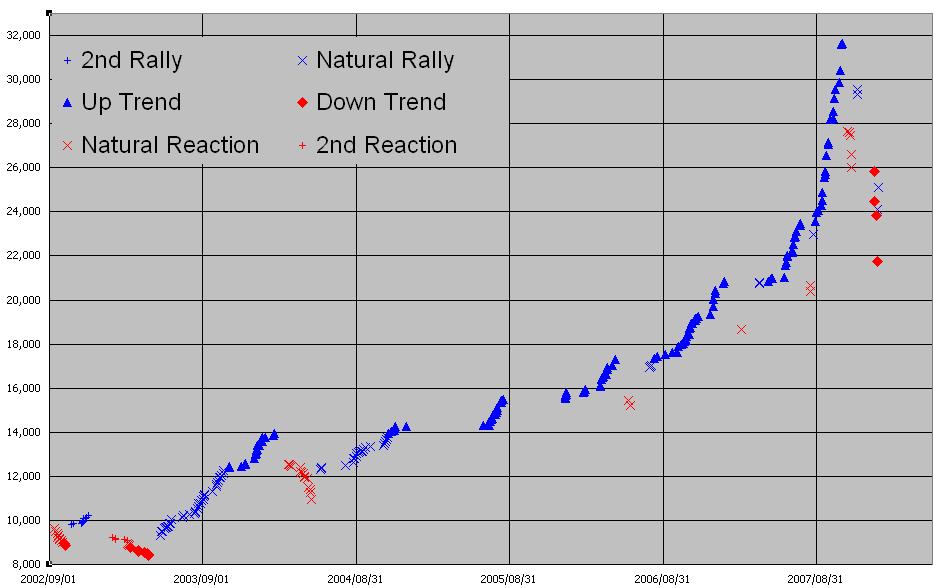
There are around 20 pages in his book detailed his method. Here we only outline his idea and use the following figure as an example:

1. Up Trend: Suppose the stock is rising and we become bearish on the stock owing to some fundamental reason. We should not short at this stage and should wait for a better opportunity to short. At this stage, we only record the closing price in a column named “Up Trend” when it is higher than the last highest closing price.
2. Natural Reaction: How to eliminate minor movements? Livermore use DISTANCE to remove minor movements. If the stock closes significantly lower than the last highest closing price, it is in the Natural Reaction Stage. My definition of “significantly lower” for HSI is 10% of the last highest closing price in the column “Up Trend”. In this stage, we record in a column named “Natural Reaction” only when the closing price is lower than the last lowest closing price.
3. Natural Rally. When the stock closes significantly higher than the last lowest closing price in the column “Natural Reaction”, it is in the Natural Rally Stage. Now we have 2 pivotal points, the highest closing price in “Up Trend” and the lowest closing price in “Natural Reaction”. The price action around pivotal point deserves scrutiny. In this stage, we record in a column named “Natural Rally” only when the closing price is higher than the last highest closing price.
4. Livermore suggested shorting when the test of the highest closing price in “Up Trend” fails. My Definition of test failure for HSI is it closes around 5% lower than the last highest closing price in the column “Natural Rally”.
The above is only a simplified version of his recording method. His recording sheet consists of 6 columns, namely Up Trend, Down Trend, Natural Reaction, Natural Rally, Secondary Reaction and Secondary Rally, and handles many more scenarios, such as test success, fake test success etc. The following is my record of HSI using JL’s method. The minor movements were eliminated as illustrated.

In his book "How to trade in stocks", Jesse Livermore, a famous speculator in the early 20th century and “the great bear”, discussed his trading method. Though Livermore died broke, we can still benefit from his forty-odd year experience in Wall Street. He emphasized to trade an unstoppable long-term trend and to get in somewhat near the beginning.
“Real movements do not end the day they start. It takes time to complete the end of a genuine movement.” p.29
“It has always been my experience that I never benefited much from a move if I did not get in at somewhere near the beginning of that move. And the reason is that I missed the backlog of profit which is very necessary to provide the courage and patience to sit through a move until the end comes-and to stay through any minor reactions or rallies which were bound to occur from time to time before the movement had completed its course.” p.46
Though Livermore was famous for his tape-reading and was regarded by many people as a technical trader, I think he was virtually a “techno-fundamentalist” as he digested lots of fundamental and market information in his normal trading days. After forming an opinion about the market or a particular stock, it is the TIMING he wanted to discuss in the book. Many of us probably have the experience of getting nothing out of the market though our opinion on the market direction was right. Maybe we get in the trend too late or we are scared out by a vigorous reaction. In the worst case we may have same experience as Jim Rogers’, who in 1970 shorted a stock at 48 and had to cover the position when the stock went up to 72. The stock eventually went up to 96 and then down to 2. Right but lost! Seems familiar? How could Livermore recognize the trend beginning?
“I determined to eliminate all the minor movements.” p.82
“I wanted to find out what constituted the beginning of a Natural Reaction or a Natural Rally. So I began checking the distances of price movements. First I based my calculation on one point. That was no good. Then two points, and so on, until finally I arrived at a point that represented what I thought should constitute the beginning of a Natural Reaction or Natural Rally.” p.83
There are around 20 pages in his book detailed his method. Here we only outline his idea and use the following figure as an example:

1. Up Trend: Suppose the stock is rising and we become bearish on the stock owing to some fundamental reason. We should not short at this stage and should wait for a better opportunity to short. At this stage, we only record the closing price in a column named “Up Trend” when it is higher than the last highest closing price.
2. Natural Reaction: How to eliminate minor movements? Livermore use DISTANCE to remove minor movements. If the stock closes significantly lower than the last highest closing price, it is in the Natural Reaction Stage. My definition of “significantly lower” for HSI is 10% of the last highest closing price in the column “Up Trend”. In this stage, we record in a column named “Natural Reaction” only when the closing price is lower than the last lowest closing price.
3. Natural Rally. When the stock closes significantly higher than the last lowest closing price in the column “Natural Reaction”, it is in the Natural Rally Stage. Now we have 2 pivotal points, the highest closing price in “Up Trend” and the lowest closing price in “Natural Reaction”. The price action around pivotal point deserves scrutiny. In this stage, we record in a column named “Natural Rally” only when the closing price is higher than the last highest closing price.
4. Livermore suggested shorting when the test of the highest closing price in “Up Trend” fails. My Definition of test failure for HSI is it closes around 5% lower than the last highest closing price in the column “Natural Rally”.
The above is only a simplified version of his recording method. His recording sheet consists of 6 columns, namely Up Trend, Down Trend, Natural Reaction, Natural Rally, Secondary Reaction and Secondary Rally, and handles many more scenarios, such as test success, fake test success etc. The following is my record of HSI using JL’s method. The minor movements were eliminated as illustrated.


2009年6月28日 星期日
The Stock Market is People

Just want to share with you the wisdom of Bernard Baruch (1870 – 1965), a very wise speculator and several times presidential adviser.
"I doubt that anything I write will change this. To many persons Wall Street will always remain a place to bet and gamble. Still, the stock market is far more than an air-conditioned indoor race track.
Actually it could be termed the total barometer for our civilization. The price of stocks – and commodities and bonds as well – are affected by literally anything and everything that happens in our world, from new inventions and the changing value of the dollar to vagaries of the weather and the threat of war or the prospect of peace. But these happenings do not make themselves felt in Wall Street in an impersonal way, like so many jigglings on a seismograph. What registers in the stock market’s fluctuations are not the events themselves but the human reactions to these events, how millions of individual men and women feel these happenings may affect the future.
Above all else, in other words, the stock market is people. It is people trying to read the future. And it is this intensely human quality that makes the stock market so dramatic an areana in which men and women pit their conflicting judgments, their hopes and fears, strengths and weaknesses, greeds and ideals.
Of course, I did not know or even sense any of this when I first went into Wall Street to work as an office boy and runner. I made my full quota of mistakes – being ambitious and energetic, probably more than my share. One could say that my whole career in Wall Street proved one long process of education in human nature.
And as I moved into public life I was to find that what I had learned about people from my speculator days applied equally to all other human affairs. Human nature remained human nature whether it stood bent over a stock ticker or spoke from the White House, whether it sat in on the councils of war or at peace conferences, whether it was concerned with making money or trying to control atomic energy. "
Bernard Baruch, My Own Story, Buccaneer, 1957, p.84.
40% Market, 30% Sector, 30% Stock
Steven A. Cohen (about 1956 - ), a legendary stock trader, was interviewed in Jack Schwager's Stock Market Wizards.
Jack: Did your economics education at Wharton help at all in your career as a stock trader?
Cohen: Not much. A few things they taught you were helpful.
Jack: Like what?
Cohen: They taught you that 40 percent of a stock's price movement was due to the market, 30 percent to the sector, and only 30 percent to the stock itself, which is something that I belive is true. I don't know if the percentages are exactly correct, but conceptually the idea makes sense.
From: Jack D. Schwager, Stock Market Wizards, Harper Business, 2003, p.269.
Jack: Did your economics education at Wharton help at all in your career as a stock trader?
Cohen: Not much. A few things they taught you were helpful.
Jack: Like what?
Cohen: They taught you that 40 percent of a stock's price movement was due to the market, 30 percent to the sector, and only 30 percent to the stock itself, which is something that I belive is true. I don't know if the percentages are exactly correct, but conceptually the idea makes sense.
From: Jack D. Schwager, Stock Market Wizards, Harper Business, 2003, p.269.
投機者的存在價值
原刊於 2006.12.17
記得讀書年代,見到身邊同學炒賣證券賺錢,並希望將來以此作為職業,心裡頗不以為然。當時我認為投機炒賣對社會無甚貢獻。一般的職業以生產貨物或提供服務來貢獻社會。醫生救人,教師作育英才,科學家發現真理,藝術家造就動人的作品,廚師煮出美味的食物。那投機者為社會提供了甚麼?
這個問題不了了之。直到最近,因為太熱愛投機,甚至妄想以此為生,有點迫切為這問題得出一個自己滿意的答案。最常聽到的投機者的社會貢獻,是為資本市場提供流通性(liquidity)。投機者辛辛苦苦,只為提供流通性?
我認為投機者的社會價值如下:
為了在市場覓得回報,投機者必須不斷學習和進步,投機能力的提升已是對社會的一種貢獻。社會的發展得力於各方面的知識累積和能力進步。提升投機能力,亦即是為市場更成熟出一分力。資本市場令資本更有效運用,所以有價值。然資本市場由眾多參與者組成。幼嫩的參與者令市場不穩定,容易產生社會問題。例如七三、八七股災,很多人傾家蕩產,甚至可能影響社會的生產秩序。
運動員的天職是不斷進步,以贏取比賽錦標;投機者的天職是不斷進步,持續不斷地在市場上贏取金錢。
簡言之,投機者善用資本。
以上是從社會的角度去考慮投機者的價值,我們亦可以從個人的角度去考慮:
我相信世上最幸福的事莫過於做自己喜愛做的事,並以此為生,並以不傷害別人為原則。「不傷害別人」需要略加闡釋。如果有人喜歡當強盜或騙子,他們當然可以以此為生。但他們謀生時,必然會傷害別人。強盜在別人不願意的情況下,強行掠奪他們的財產;騙徒以欺瞞的手法騙取他人的財產。因此,我認為不傷害別人是應有的原則。
發放假消息以圖獲利的操盤與行騙無異,不足取也。
在任何的比賽裡,必然有勝方及負方。投機市場即使如何公平,亦分優劣。哪,比賽的負方或市場的劣方是否受到傷害呢?答案是否定的,因為他們都是自願參加這個遊戲,並有公平的機會去爭取勝利。
如果我們是屬於市場的,每天投機不是很有意義嗎?
記得讀書年代,見到身邊同學炒賣證券賺錢,並希望將來以此作為職業,心裡頗不以為然。當時我認為投機炒賣對社會無甚貢獻。一般的職業以生產貨物或提供服務來貢獻社會。醫生救人,教師作育英才,科學家發現真理,藝術家造就動人的作品,廚師煮出美味的食物。那投機者為社會提供了甚麼?
這個問題不了了之。直到最近,因為太熱愛投機,甚至妄想以此為生,有點迫切為這問題得出一個自己滿意的答案。最常聽到的投機者的社會貢獻,是為資本市場提供流通性(liquidity)。投機者辛辛苦苦,只為提供流通性?
我認為投機者的社會價值如下:
為了在市場覓得回報,投機者必須不斷學習和進步,投機能力的提升已是對社會的一種貢獻。社會的發展得力於各方面的知識累積和能力進步。提升投機能力,亦即是為市場更成熟出一分力。資本市場令資本更有效運用,所以有價值。然資本市場由眾多參與者組成。幼嫩的參與者令市場不穩定,容易產生社會問題。例如七三、八七股災,很多人傾家蕩產,甚至可能影響社會的生產秩序。
運動員的天職是不斷進步,以贏取比賽錦標;投機者的天職是不斷進步,持續不斷地在市場上贏取金錢。
簡言之,投機者善用資本。
以上是從社會的角度去考慮投機者的價值,我們亦可以從個人的角度去考慮:
我相信世上最幸福的事莫過於做自己喜愛做的事,並以此為生,並以不傷害別人為原則。「不傷害別人」需要略加闡釋。如果有人喜歡當強盜或騙子,他們當然可以以此為生。但他們謀生時,必然會傷害別人。強盜在別人不願意的情況下,強行掠奪他們的財產;騙徒以欺瞞的手法騙取他人的財產。因此,我認為不傷害別人是應有的原則。
發放假消息以圖獲利的操盤與行騙無異,不足取也。
在任何的比賽裡,必然有勝方及負方。投機市場即使如何公平,亦分優劣。哪,比賽的負方或市場的劣方是否受到傷害呢?答案是否定的,因為他們都是自願參加這個遊戲,並有公平的機會去爭取勝利。
如果我們是屬於市場的,每天投機不是很有意義嗎?
坐盤致富
Jesse Livermore的智慧,真是字字珠機:
"… After spending many years in Wall Street and after making and losing millions of dollars, I want to tell you this: It never was my thinking that made the big money for me. It was always my sitting. Got that? My sitting tight. It is no trick at all to be right on the market. You always find lots of early bulls in bull markets and lots of early bears in bear markets. I have known many men who were right at exactly the right time, and began buying or selling stocks when prices were at the very level which should show the greatest profit. And their experience invariably matched mine; that is, they made no real money out of it. Men who can both be right and sit tight are uncommon. I found it one of the hardest things to learn. But it is only after a stock operator has firmly grasped this that he can make big money. It is literally true that millions come easier to a trader after he knows how to trade than hundreds did in the days of his ignorance."
~~ Reminiscences of a Stock Operator (1923)
當我們不斷在股市選出明星股而一無所得時,定必對以上文字很有共鳴吧!
當持中線倉時,如果經驗覺得短線下跌的概率甚高且幅度也許甚大,我們仍要坐定定,克制自己甚麼也不做,唯恐失去現在擁有的倉;然後眼白白看著已有的利潤一點點的消失,我們的短線預期一點點實現。那一種忍耐...
I Wait.
… after forming a definite opinion with respect to a certain stock or stocks – do not be too anxious to get into it. Wait and watch the action of that stock or stocks marketwise. Have a fundamental basis to be guided by. Say, for instance, a stock is selling around $25.00 and has been holding within a range of $22.00 to $28.00 for a considerable period. Assuming that you believe that the stock should eventually sell at $50.00, and it is $25.00 at the time, and in your opinion it will sell at $50.00, have patience and wait until the stock becomes active, until it makes a new high, say around $30.00, You will then know that marketwise you have been justified. The stock must have gone into a very strong position, or it would not have reached $30.00. Having done so, it is altogether likely that it is on its way to a very definite advance – the move is on. That is the time for you to back your opinion. Don’t let the fact that you did not buy at $25.00 cause you any aggravation. The chances are if you have, you would have become tired of waiting and would have been out of it when the move started, because having once gotten out at a lower price, you would have become disgruntled and would not have gone back in when you should have. (1)
(1) Jesse L. Livermore, How to Trade in Stocks, Duell, Sloan & Pearce, 1940, p.9.
(1) Jesse L. Livermore, How to Trade in Stocks, Duell, Sloan & Pearce, 1940, p.9.
2009年6月13日 星期六
投資定義 Definition of Investment
原刊於2006.11.19
在經濟學上,費沙 (Irving Fisher,1867-1947) 對投資的理解是:
Investment is the balancing of consumption over time. (1)
十分簡潔。譬如說,我有一千元,本可以現在用來吃喝玩樂,但我儲起來留待將來讀書用。這個儲蓄的決定就是投資。但這個定義不能對證券買賣行為作出分類。證券買賣並不涉及消費,只是一種資產配置行為。
且看價值投資之父 Ben Graham(1894-1976) 的定義:
An investment operation is one which, upon thorough analysis promises safety of principal and an adequate return. (2)
也是十分簡潔。根據這個定義,許多散戶盲目跟風炒賣的行為就不是投資;做過市場分析而開舖做生意是投資。但筆者對這定義仍不滿意。現在有很多交易系統是經過嚴格測試,並且在市場上獲得不俗的回報。把這些技術交易系統的買賣稱為投資,相信不是Graham 的本意。
我認為,根據Graham在 <The Intelligent Investor> 對投資的闡述和一些著名投資者的作為,以下的一點最能判別出一個交易是否投資:
(我的定義) 投資者明白持貨的價值,不會純粹因為市價下跌而止蝕離場。
讓我稍作補充:
1) 明白持貨的價值是主觀的和個人的。有人喜歡用PEG(PE/Growth),有人抗拒;有人目光遠大,看出幾年後的發展,有人見不到近處;甚至有人認為價值是子虛烏有。因為功力不足、眼光不準而輸錢收埸也算是投資,不過是投資失敗罷了。
2) 有的散戶盲目崇拜買入後持有(Buy and Hold),而不理會持貨的價值或基本因素的轉變。雖然他們不會純粹因為市價下跌而止蝕離場,但因他們不明白持貨的價值,故他們不是投資者。
3) 投資者的絕活是對價值的判斷。市場先生Mr. Market有時是不理智的,否則價值(Value) 和價格(Price)不可能相差太遠。投資者把握市場先生不理智的時間,當價格遠低於價值時,趁低吸納;當價格高於價值時,趁高沽出。市場是大眾的反映,故投資者在出手買入或賣出時,必然是相反理論信徒。
4) 所有交易必有買入原因和離場原因。買入原因林林種種:便宜 (Undervalue)、創新高、技術訊號…。小弟也很喜歡發掘便宜貨,但小弟不自視為投資者,原因是小弟會因價格下跌而止蝕離場。真正的投資者持貨的原因是估值考慮,價格下跌是不影響其估值的,所以他們不會因為市價下跌而止蝕離場,甚至會考慮加碼。
5) 交易系統不明白價值,亦會因價格下跌而作出止蝕,故其買賣不是投資。
6) 離場原因有很多。如果投資者發現估值已完全反映,或基本因素出現變化而離場,並不違反以上定義。
7) 明白持貨的價值,但因為借貸太重、或資本不足,因市價下跌而被迫斬倉離場,也算是投資。其離埸原因是操作失敗罷了。
8) 投資與持貨的時間長度無關。如果今日撿了便宜貨,明日市場終於發現其價值而大幅上升至估值完全反映,沽貨獲利離場。雖然持貨只有一天,也是投資。
9) 一般開舖做生意,亦可應用以上定義。和黃的3G,市場對其估值頗負面,但和黃仍然堅持,故和黃是「投資」3G。
10) 根據小弟的定義,投資是投機的一種,並不對立。請參閱 <投機定義 Definition of Speculation>。
最後,還有一個辦法判別是否投資,就是問:
如果交易所明日起關閉三年,你會恐慌嗎?
投資者,如畢菲特等,相信是不會恐慌的。投機者,如我等,必然十分頭痛也。
(1) 張五常:經濟解釋(卷二) - 供應的行為,花千樹,二零零二,第33頁。
(2) Benjamin Graham, The Intelligent Investor 4th Rev Ed., Harper Business, 1973, p.1.
在經濟學上,費沙 (Irving Fisher,1867-1947) 對投資的理解是:
Investment is the balancing of consumption over time. (1)
十分簡潔。譬如說,我有一千元,本可以現在用來吃喝玩樂,但我儲起來留待將來讀書用。這個儲蓄的決定就是投資。但這個定義不能對證券買賣行為作出分類。證券買賣並不涉及消費,只是一種資產配置行為。
且看價值投資之父 Ben Graham(1894-1976) 的定義:
An investment operation is one which, upon thorough analysis promises safety of principal and an adequate return. (2)
也是十分簡潔。根據這個定義,許多散戶盲目跟風炒賣的行為就不是投資;做過市場分析而開舖做生意是投資。但筆者對這定義仍不滿意。現在有很多交易系統是經過嚴格測試,並且在市場上獲得不俗的回報。把這些技術交易系統的買賣稱為投資,相信不是Graham 的本意。
我認為,根據Graham在 <The Intelligent Investor> 對投資的闡述和一些著名投資者的作為,以下的一點最能判別出一個交易是否投資:
(我的定義) 投資者明白持貨的價值,不會純粹因為市價下跌而止蝕離場。
讓我稍作補充:
1) 明白持貨的價值是主觀的和個人的。有人喜歡用PEG(PE/Growth),有人抗拒;有人目光遠大,看出幾年後的發展,有人見不到近處;甚至有人認為價值是子虛烏有。因為功力不足、眼光不準而輸錢收埸也算是投資,不過是投資失敗罷了。
2) 有的散戶盲目崇拜買入後持有(Buy and Hold),而不理會持貨的價值或基本因素的轉變。雖然他們不會純粹因為市價下跌而止蝕離場,但因他們不明白持貨的價值,故他們不是投資者。
3) 投資者的絕活是對價值的判斷。市場先生Mr. Market有時是不理智的,否則價值(Value) 和價格(Price)不可能相差太遠。投資者把握市場先生不理智的時間,當價格遠低於價值時,趁低吸納;當價格高於價值時,趁高沽出。市場是大眾的反映,故投資者在出手買入或賣出時,必然是相反理論信徒。
4) 所有交易必有買入原因和離場原因。買入原因林林種種:便宜 (Undervalue)、創新高、技術訊號…。小弟也很喜歡發掘便宜貨,但小弟不自視為投資者,原因是小弟會因價格下跌而止蝕離場。真正的投資者持貨的原因是估值考慮,價格下跌是不影響其估值的,所以他們不會因為市價下跌而止蝕離場,甚至會考慮加碼。
5) 交易系統不明白價值,亦會因價格下跌而作出止蝕,故其買賣不是投資。
6) 離場原因有很多。如果投資者發現估值已完全反映,或基本因素出現變化而離場,並不違反以上定義。
7) 明白持貨的價值,但因為借貸太重、或資本不足,因市價下跌而被迫斬倉離場,也算是投資。其離埸原因是操作失敗罷了。
8) 投資與持貨的時間長度無關。如果今日撿了便宜貨,明日市場終於發現其價值而大幅上升至估值完全反映,沽貨獲利離場。雖然持貨只有一天,也是投資。
9) 一般開舖做生意,亦可應用以上定義。和黃的3G,市場對其估值頗負面,但和黃仍然堅持,故和黃是「投資」3G。
10) 根據小弟的定義,投資是投機的一種,並不對立。請參閱 <投機定義 Definition of Speculation>。
最後,還有一個辦法判別是否投資,就是問:
如果交易所明日起關閉三年,你會恐慌嗎?
投資者,如畢菲特等,相信是不會恐慌的。投機者,如我等,必然十分頭痛也。
(1) 張五常:經濟解釋(卷二) - 供應的行為,花千樹,二零零二,第33頁。
(2) Benjamin Graham, The Intelligent Investor 4th Rev Ed., Harper Business, 1973, p.1.
投機定義 Definition of Speculation
原刊於2006.10.02
長久以來,投機 (Speculation) 有許多不同的定義。我採納以下Baruch對投機的定義:
Modern usage has made the term "speculator" a synonym for gambler and plunger. Actually the word comes from the Latin speculari, which means to spy out and observe.
I have defined a speculator as a man who observes the future and acts before it occurs. To be able to do this successfully - and it is an ability of priceless value in all human affairs, including the making of peace and war - three things are necessary:
First, one must get the facts of a situation or problem.
Second, one must form a judgment as to what those facts portend.
Third, one must act in time - before it is too late.
I have heard many men talk intelligently, even brilliantly, about something - only to see them proven powerless when it comes to acting on what they believe. (1)
根據以上定義,所有經過精密計算的投資 (Investment) 都是投機。當然,這個定義不是多數人採納的。譬如說,價值投資之父Ben Graham是這樣區分投資與投機的:
An investment operation is one which, upon thorough analysis promises safety of principal and an adequate return. Operations not meeting these requirements are speculative. (2)
(1) Baruch, My Own Story, Buccaneer, 1957, p.105.
(2) Benjamin Graham, The Intelligent Investor 4th Rev Ed., Harper Business, 1973, p.1.
長久以來,投機 (Speculation) 有許多不同的定義。我採納以下Baruch對投機的定義:
Modern usage has made the term "speculator" a synonym for gambler and plunger. Actually the word comes from the Latin speculari, which means to spy out and observe.
I have defined a speculator as a man who observes the future and acts before it occurs. To be able to do this successfully - and it is an ability of priceless value in all human affairs, including the making of peace and war - three things are necessary:
First, one must get the facts of a situation or problem.
Second, one must form a judgment as to what those facts portend.
Third, one must act in time - before it is too late.
I have heard many men talk intelligently, even brilliantly, about something - only to see them proven powerless when it comes to acting on what they believe. (1)
根據以上定義,所有經過精密計算的投資 (Investment) 都是投機。當然,這個定義不是多數人採納的。譬如說,價值投資之父Ben Graham是這樣區分投資與投機的:
An investment operation is one which, upon thorough analysis promises safety of principal and an adequate return. Operations not meeting these requirements are speculative. (2)
(1) Baruch, My Own Story, Buccaneer, 1957, p.105.
(2) Benjamin Graham, The Intelligent Investor 4th Rev Ed., Harper Business, 1973, p.1.
訂閱:
文章 (Atom)


